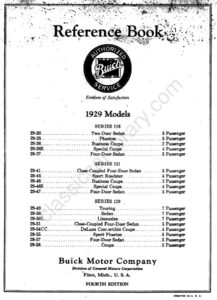
Pages 32–39 (8 pages)
Fuel System
From the 1929 Buick Reference Book (Owner’s Manual)
Opens with generator charging faults, then the fuel system: gasoline tank, AC diaphragm fuel pump with strainer and pulsator, and the Marvel automatic air valve carburetor with its heat-controlled riser. Explains the heat control lever positions (heat on, medium, heat off) with valve diagrams, starting procedure, setting the gasoline and air adjustments, rich and lean mixture symptoms, and the AC centrifugal air cleaner. A two-page chassis lubrication chart is bound in this section (pp. 33–34).
Read this section free, starting at page 32What this section covers
- Fuel system layout
- AC fuel pump operation
- Marvel carburetor construction
- Heat control lever settings
- Carburetor adjustment
- AC air cleaner
- Lubrication chart
- Year
- 1929
- Make
- Buick
- Vehicle
- Passenger Cars
- Type
- Owner's Manual
- Models
- Series 116, 121 and 129 (models 29-20 to 29-58)
- Pages
- 65
What’s inside
Reference book
- Title Page, Foreword and WarrantyTitle page listing every 1929 model by series, number, body style and passenger capacity, with the foreword, the anti-theft "Lock your car" notice, the National Automobile Chamber of Commerce standard warranty and instructions for ordering Buick parts by serial number, model and style.pp. 1–4
- Chassis Views and Specificationspp. 5–10
- Operation and Carepp. 11–14
- Power System: Enginepp. 15–19
- Cooling SystemRadiator, fan and V-belt adjustment, fan hub lubrication, centrifugal water pump packing, the 120-degree thermostat, temperature gauge, draining, an alcohol anti-freeze table for Series 116 and Series 121/129, and cleaning the system with sal soda.pp. 20–21
- Starting, Lighting and Ignitionpp. 22–29
- Electrical AdjustmentsOwner troubleshooting for the electrical system: starter fails to crank, lights will not burn, current limit relay vibrates, lights flare up, short lamp life, engine fails to fire or fires irregularly, and ammeter showing discharge; generator charging faults continue on the next page.pp. 30–31
- Fuel Systempp. 32–39
- Driving System: ClutchHow the Buick multiple disc clutch works, with a sectional view of the clutch assembly; the following page on lubrication and riding the clutch is a poor scan.pp. 40–41
- TransmissionSelective sliding gear three-speed transmission with sectional views for Series 116 and Series 121/129, control lever positions and gear-shift diagram, transmission lubrication, the universal joint, and the pinion shaft and torque tube with pinion depth adjustment.pp. 42–44
- Rear and Front Axlespp. 45–48
- Speedometer and Steering GearSpeedometer and its drive, the worm and split nut steering gear with sectional view, steering gear adjustment and lubrication, the steering gear and ignition lock, and steering wheel position adjustment. Page 50 is a poor scan.pp. 49–50
- Brakes, Springs and Wheelspp. 51–55
- TiresLow pressure tires (30 x 5.50 on Series 116, 32 x 6.50 on Series 121 and 129), illustrated forms of damage from underinflation, and a table of recommended front and rear tire pressures for every 1929 model. The general lubrication chapter begins at the foot of p. 57.pp. 56–57
- General LubricationEngine oil capacities and S.A.E. viscosity recommendations, the Zerk high pressure lubricating system and compressor, and lubrication schedules every 500, 1000 and 2000 miles listing each fitting and lubricant.pp. 58–59
- Care of the Car, Storage and First AidCrankcase refill capacities, care of the Duco finish, closed and open car upholstery, squeaks and rattles, tops and curtains, laying up the car for storage, and first-aid suggestions for an engine that will not start, stops or misses.pp. 60–62
- Buick Branches and IndexAddresses of Buick branches and distributors and United Motors Service branches, followed by the alphabetical index.pp. 63–65
Other manuals for this vehicle
 1929Specifications1929 Buick Detailed Specifications
 1933Service Manual1933 Buick Shop Manual
 1934Service Manual1934 Buick Series 40 Shop ManualBPS-1.19
 1934Service Manual1934 Buick Series 50 60 90 Shop ManualBPS-1.18
 1940Parts Catalog1940-1972 Buick Chassis and Body Illustration Catalog
 1942Service Manual1942 Buick Shop ManualBPS-1.27
 1946Service Manual1946 Buick Shop Manual SupplementBPS 1.28
 1940Service Bulletin1947 GM Product Service Bulletin – December 1947 Issue