Pages 18–32 (15 pages)
Engine
From the 1928 Chrysler Imperial 80 Instruction Book
General description of the L-head six with rubber-insulated rear supports, force-feed lubrication, thermostat and muffler cut-out, followed by repair operations. It gives piston and ring clearances, the seven-bearing counterweighted crankshaft, valve materials, setting and checking valve timing with a gauge rod above No. 6 piston, tappet clearances, valve grinding with cylinder head removal, and timing chain adjustment by moving the generator. Full-page views show both sides of the power plant and side, front and center sections of the engine.
Read this section free, starting at page 18What this section covers
- Pistons, rings and fitting clearances
- Crankshaft and connecting rod bearings
- Setting and checking valve timing
- Tappet clearances
- Valve grinding and cylinder head installation
- Timing chain adjustment
- Engine sectional views (Figs. 1–7)
- Year
- 1928
- Make
- Chrysler
- Vehicle
- Imperial, Passenger Cars
- Type
- Owner's Manual
- Models
- Imperial "80" six-cylinder: Phaeton, Roadster, Coupe, 5- and 7-passenger Sedan, Sedan Limousine
- Publication
- Third Edition, October 1927
- Pages
- 86
What’s inside
Covers and front matter
- Title Page, License Data and ContentsCover (Third Edition, October 1927), license data with engine dimensions and shipping weights by body style, the table of contents, the index to illustrations and Chrysler Sales Corporation's message to owners.pp. 1–7
- Back CoverCover pages; the scan ends here without the tools list, specifications, parts and warranty pages listed in the contents.pp. 85–86
Inspection, care and lubrication
General description and repair operations
- Enginepp. 18–32
- Cooling SystemRadiator care and flushing, steaming, fan belt and water pump packing adjustment, the thermostat, the dash thermometer and non-freezing solutions.pp. 33–34
- Fuel Systempp. 35–39
- Electrical Systempp. 40–53
- Power Transmission Systempp. 54–70
- Chrysler Hydraulic Four-Wheel Brakespp. 71–79
Corrective measures and operation
- Corrective MeasuresTroubleshooting lists for an engine that fails to start, stops, misses, loses power or compression, pops back through the carburetor, overheats or knocks.pp. 80–81
- OperationPreparing the car for use, starting the engine with spark and throttle levers, a front compartment illustration of the controls, shifting the three-speed transmission and stopping the car.pp. 82–84
Other manuals for this vehicle
 1927Owner's Manual1927 Chrysler Imperial 80 Instruction BookSecond Edition, September 15, 1926
 1930Owner's Manual1930 Chrysler Imperial 8 Instruction BookFirst Edition, July 1930
 1931Owner's Manual1931 Chrysler Imperial 8 Instruction BookFourth Edition, June 1931
 1933Owner's Manual1933 Chrysler Imperial CQ Instruction Book
 1934Service Manual1934–1936 Chrysler Master Maintenance Manual
 1941Service Manual1941–1948 Chrysler Shop ManualD-11298
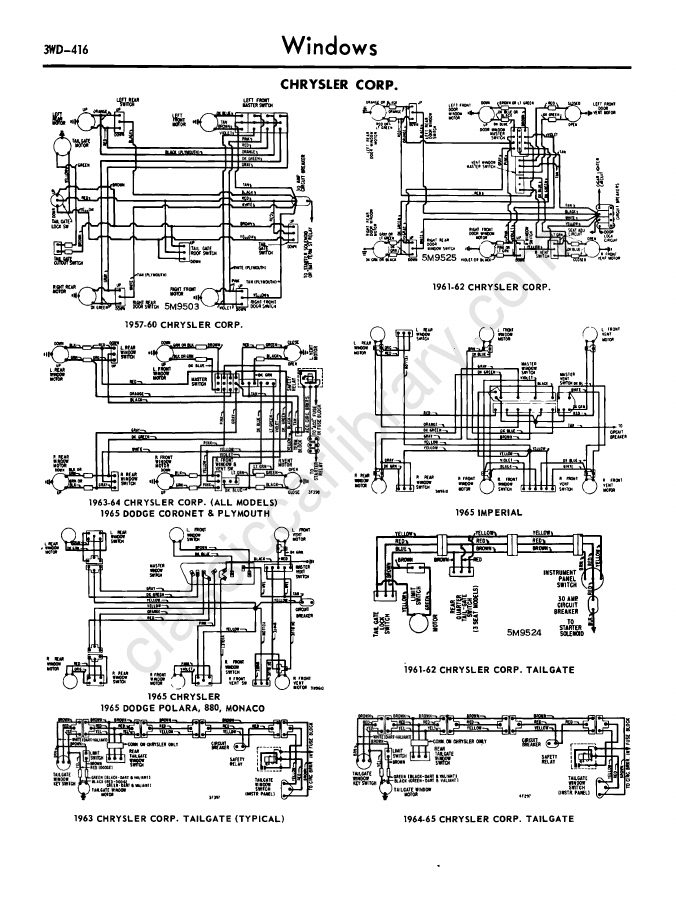 1957Wiring Diagrams1957–1965 Ford, GM and Chrysler Accessory Wiring Diagrams