Pages 1–4 (4 pages)
Description and Operating Instructions
From the 1956 Pontiac Air Conditioning Manual
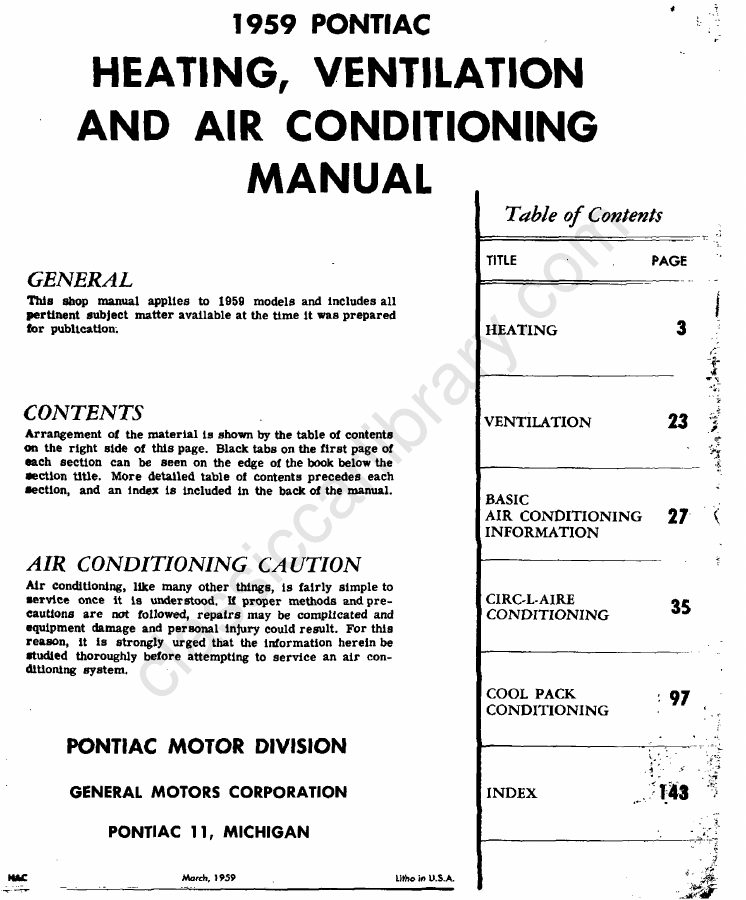
Title page and foreword, then how the 1956 Pontiac system works from the driver's seat: filtered outside or recirculated air, three instrument panel outlets, the OFF, VENT, ON, OUTSIDE and INSIDE control lever positions and the two-speed fan switch. Recommended settings are given for fast cool-down, city driving and highway cruising, followed by a list of parts that differ on air-conditioned cars.
Read this section free, starting at page 1What this section covers
- Air outlets, nozzles and control panel
- Control lever positions and fan switch
- Recirculation of inside air
- Recommended control settings by driving condition
- Differences in the air conditioned car: springs, generator, radiator, cap, fan, belts
- Cooling system capacities
- Year
- 1956
- Make
- Pontiac
- Type
- Service Manual
- Models
- 1956 Pontiac passenger cars with factory air conditioning (Frigidaire five-cylinder compressor)
- Publication
- S-5604AC
- Pages
- 50
What’s inside
Air conditioning shop manual
- Description and Operating Instructionspp. 1–4
- Principles of Operationpp. 5–19
- General Information on Refrigeration Servicepp. 20–24
- Inspection, Periodic Service and Adjustments on CarNew car pre-delivery and 2000-mile inspections, periodic filter cleaning and condenser checks, and on-car adjustments of the compressor belt, air valve and thermostat control cables, clutch and relay control switch and thermostatic expansion valve.pp. 25–27
- Minor Services and Repairs: MechanicalRepairs that do not open the refrigeration system: control panel, control assembly and cables, blower switch, nozzles, air inlet and filter, blower, air distributor and thermostat, and moving the compressor to service the engine. Pages are in reverse order in this scan.pp. 28–30
- Minor Services and Repairs: Refrigerationpp. 31–43
- Testing and Diagnosispp. 44–48
- Specifications and Special ToolsSpecifications that differ on air-conditioned cars (compressor, belts, Freon capacity, generator, regulator, torques) and the list of J-numbered special tools for servicing the system.pp. 49–50