Pages 9–18 (10 pages)
Operation and Care
From the 1933 Chrysler Imperial CQ Instruction Book
How to drive and look after the Imperial Eight. After the theft-protection notes and the numbered front compartment view, it explains warm and cold starting with the accelerator-operated starter, cold-weather oil, and driving with the free wheeling control button pushed in, half out or fully out. It then covers washing, lacquer care with Chrysler polishes, step-by-step lowering and raising of the sedan and coupe tops, summer and winter precautions, tire storage and laying up the car.
Read this section free, starting at page 9What this section covers
- Front compartment controls (Fig. 1)
- Starting the engine warm and cold
- Driving with the free wheeling control button
- Washing and lacquer finish care
- Lowering and raising the sedan and coupe tops
- Summer and winter precautions
- Storing the car and tires
- Year
- 1933
- Make
- Chrysler
- Vehicle
- Imperial, Passenger Cars
- Type
- Owner's Manual
- Models
- Chrysler Imperial Eight (Code CQ): sedan, rumble-seat coupe and convertible coupe
- Pages
- 118
What’s inside
Operation and care
- License Data and ContentsCover, license data (serial number locations, 3 1/4 x 4 1/2 in. bore and stroke, 33.80 N.A.C.C. horsepower, shipping weights, key rules), table of contents, index to illustrations and Chrysler's message to owners.pp. 1–8
- Operation and Carepp. 9–18
Adjustment and repair operations
- Front Axlepp. 19–24
- Rear Axlepp. 25–29
- Brakespp. 30–38
- Clutch (Automatic Control)pp. 39–46
- Cooling Systempp. 47–50
- Electrical Systempp. 51–62
- Lubrication ChartCenter-insert chassis lubrication chart for the Imperial Eight (Code CQ), showing each lubrication point with its lubricant and interval. The scan of the chart is hard to read.pp. 63–64
- Enginepp. 65–78
- Engine LubricationOil grades by season and garage conditions, the pressure lubrication circuit, normal 30–40 lb. oil pressure and relief valve adjustment, oil filter checks, why crankcase oil dilutes, draining and cleaning the oil pan and screen.pp. 79–81
- Fuel Systempp. 82–85
- Shock Absorbers and SpringsInertia-type shock absorbers and semi-elliptic springs in rubber mountings with Oilite bushings and inserts, spring bolt and cushion adjustment, and spring clip tightening.pp. 86–86
- Steering Gearpp. 87–91
- Transmissionpp. 92–95
- Transmission, Free Wheeling and Rear Axle LubricantsSeasonal free wheeling lubricant numbers for the transmission, low-temperature blends with motor oil or kerosene, and rear axle lubricant grades.pp. 96–97
- TiresTire pressures (40 lb. front, 35 lb. rear) and removing and installing tires on drop-center rims with tire irons (Figs. 25–28).pp. 98–99
- Universal Joints, Propeller Shaft and WheelsTrunnion and roller bearing universal joints and propeller shaft (Fig. 29), front wheel bearing adjustment, wheel balance and valve stem placement, and removing and fitting the demountable wood wheels.pp. 100–102
Reference and specifications
- Corrective MeasuresTroubleshooting lists for an engine that fails to start, stops, misses, loses power, lacks compression, pops back through the carburetor, overheats or knocks.pp. 103–104
- ToolsThe tool kit supplied with the car, from wheel wrench and jack to tappet wrench and high-pressure lubricant gun.pp. 105–105
- Standards of Adjustmentpp. 106–111
- Detailed Specificationspp. 112–115
- Genuine Parts, Ordering Parts and WarrantyChrysler Motors Parts Corporation genuine parts, ordering and returning parts, and the N.A.C.C. uniform 90-day or 4,000-mile warranty.pp. 116–118
Other manuals for this vehicle
 1927Owner's Manual1927 Chrysler Imperial 80 Instruction BookSecond Edition, September 15, 1926
 1928Owner's Manual1928 Chrysler Imperial 80 Instruction BookThird Edition, October 1927
 1930Owner's Manual1930 Chrysler Imperial 8 Instruction BookFirst Edition, July 1930
 1931Owner's Manual1931 Chrysler Imperial 8 Instruction BookFourth Edition, June 1931
 1934Service Manual1934–1936 Chrysler Master Maintenance Manual
 1941Service Manual1941–1948 Chrysler Shop ManualD-11298
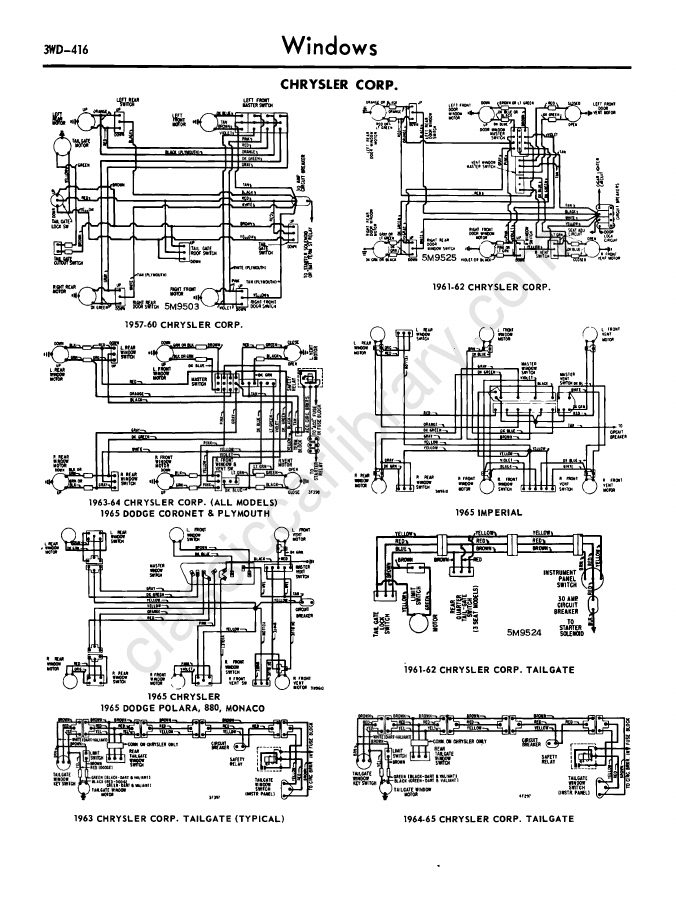 1957Wiring Diagrams1957–1965 Ford, GM and Chrysler Accessory Wiring Diagrams